
Slow Start
Pond Aeration Startup Control
Most Fish Kills Happen During Startup
Starting aeration too fast can trigger rapid turnover — causing oxygen crash and fish loss within hours.
The Universal Slow Start Control automatically ramps up pond aerator runtime over a controlled 15-day startup cycle to help reduce startup shock in stratified or low-oxygen ponds.

Patent Pending
First-of-its-kind aeration startup control.
15-Day Ramp-Up
Automatically increases to full operation.

Fail-Safe Design
Defaults to compressor run mode.
Automatic Operation
No daily timer changes or guesswork.

Designed for Aeration
Purpose-built for pond aerator startup.
Why Starting Too Fast Can Be Dangerous
A stagnant, stratified, or unmanaged pond can hold low-oxygen bottom water and gases such as hydrogen sulfide or carbon dioxide. Starting bottom-diffused aeration at full runtime can mix that water upward too quickly.
Slow starting a pond aerator gives the pond time to adjust gradually, especially during warm-weather startup, seasonal restart, or installation on stocked ponds.
What Slow Start Does
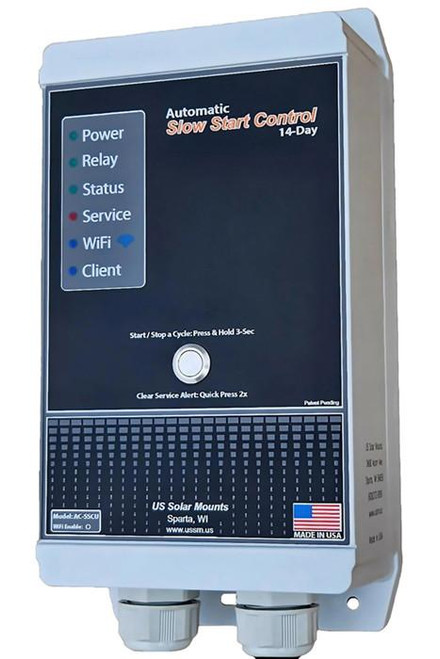
The controller replaces manual timer schedules with an automatic 15-day startup cycle. It begins with very short runtime and increases daily until the aeration system reaches normal full operation.
After the cycle completes, the controller returns the compressor to normal operation without requiring a return trip to remove temporary startup controls.
For Pond Owners
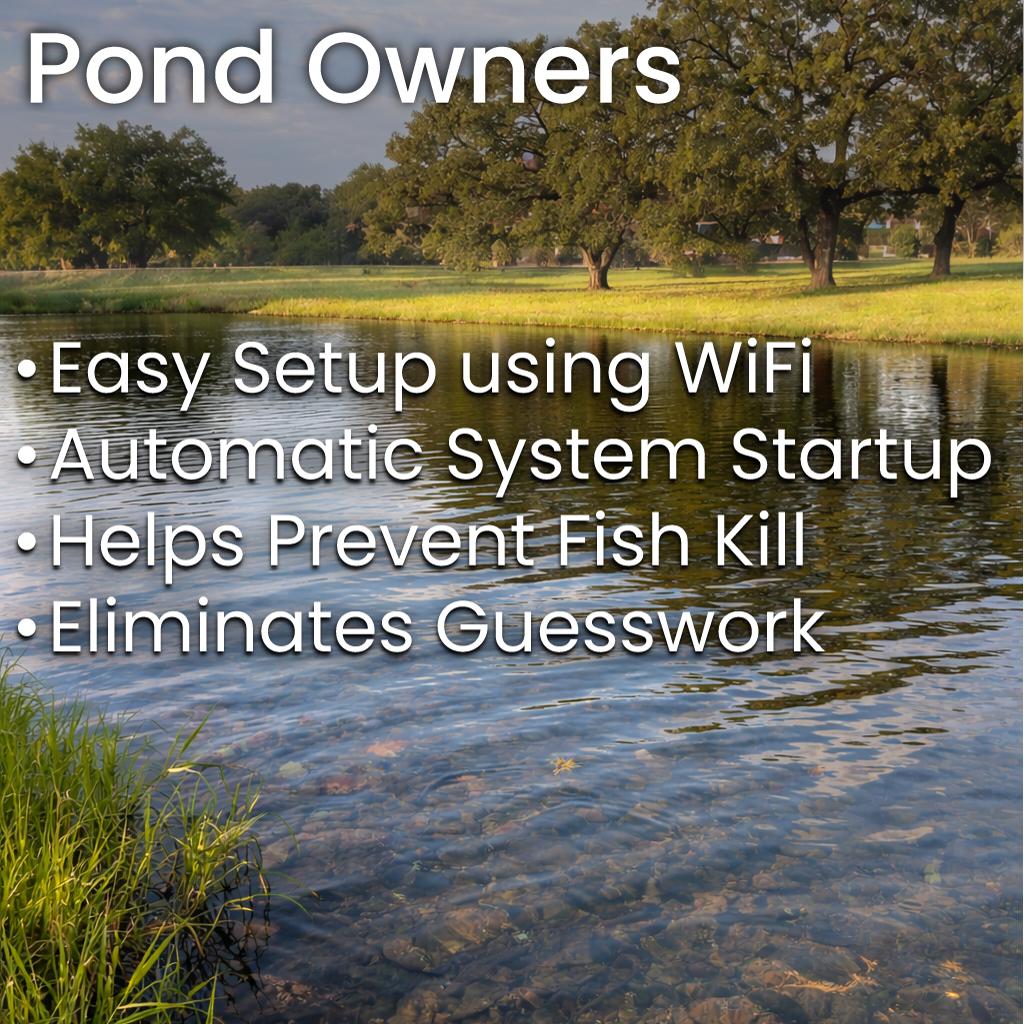
Start a new or seasonal pond aeration system with a controlled process instead of guessing at a manual timer schedule.
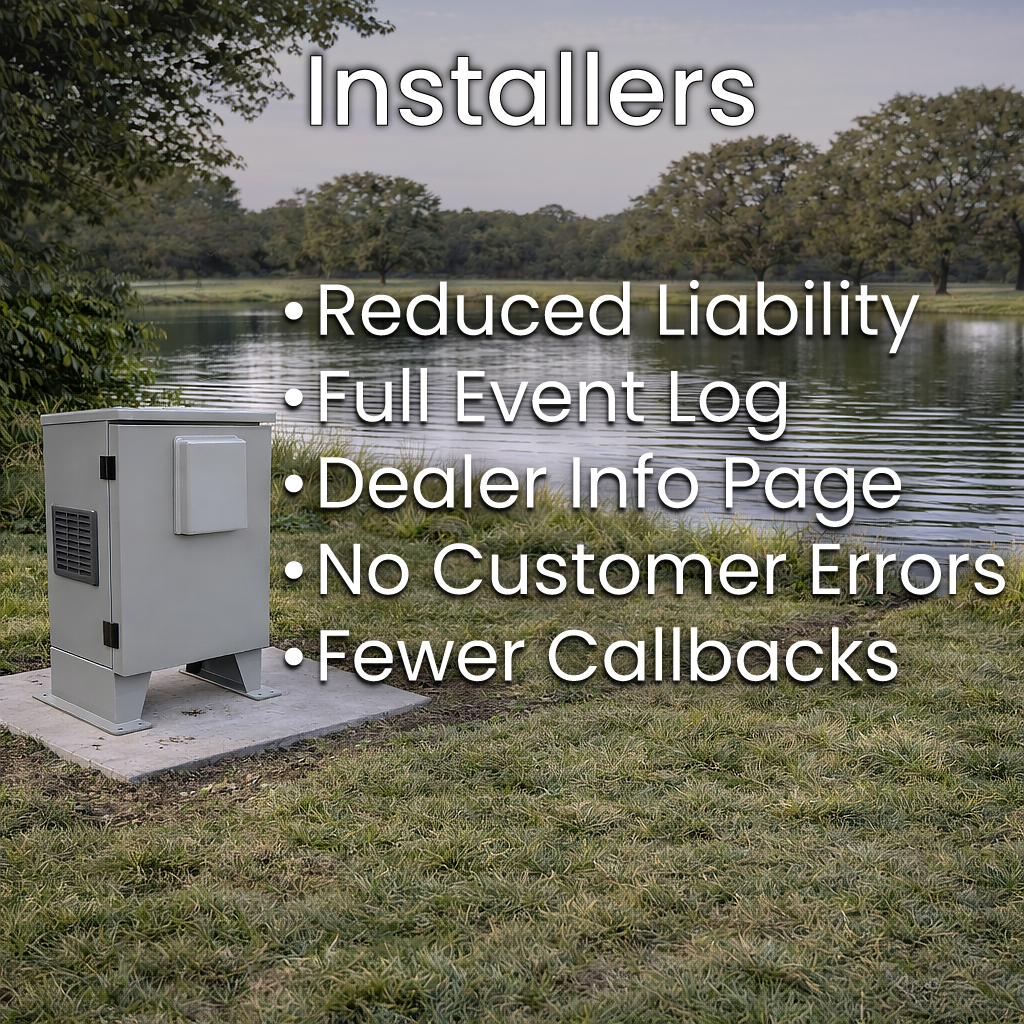
For Installers
Use a repeatable commissioning process, reduce follow-up trips, and provide a professional startup handoff for aeration customers.
Two Automatic Startup Modes
Round-the-Clock Mode
Spreads the allowed runtime across each hour. This is the default out-of-box mode and does not require the internal clock to be set before starting a cycle.
Day-Centering Mode
Creates one daily operating window centered around midday. This mode is useful when aeration startup should be concentrated during the warmer portion of the day.
Ideal for Pond Aeration Startup and Seasonal Restart
The Universal Slow Start Control is designed for pond aeration startup situations where an aerator should not be started at full runtime immediately. It is especially useful for new pond aeration systems, seasonal aerator restart, stocked ponds, deep ponds, stratified ponds, warm-weather startup, and systems that have been off for an extended period.
- New aeration system startup
- Seasonal pond aerator restart
- Warm-weather startup
- Deep or stratified ponds
- Stocked fish ponds
- Remote installations
Important: No aeration startup method can guarantee prevention of fish loss under every pond condition. A controlled slow start is intended to significantly reduce the risk associated with aggressive startup in stratified or low-oxygen ponds.
If you have questions about starting a pond aeration system safely, choosing the correct startup mode, or using the Universal Slow Start Control with your aerator, contact US Solar Mounts for assistance.
Contact Us
Frequently Asked Questions About Slow Start™
Search common questions about pond aeration startup, fish kill risk, Slow Start modes, installer use, and Universal Slow Start Control compatibility.
Showing 20 questions
1 What is a slow start controller for pond aeration?
A slow start controller manages aerator compressor runtime during startup instead of allowing full-time operation immediately. The Universal Slow Start Control gradually increases allowed compressor runtime over a controlled 15-day cycle, then returns the system to normal operation when the cycle is complete.
2 Can starting aeration too fast cause a fish kill?
Yes, in certain pond conditions. If a pond is stratified, stagnant, unmanaged, deep, or low in oxygen, starting bottom-diffused aeration at full runtime can mix low-oxygen bottom water and trapped gases upward too quickly. That sudden mixing can stress fish and increase the risk of an oxygen crash.
3 What is pond turnover?
Pond turnover is the mixing of water layers that have separated by temperature, oxygen level, or water quality. Turnover can happen naturally, but it can also be forced too quickly if bottom aeration is started aggressively in a stratified pond.
4 What happens when low-oxygen bottom water mixes too quickly?
When low-oxygen bottom water mixes upward too quickly, fish can be exposed to reduced oxygen levels and gases such as hydrogen sulfide or carbon dioxide. A controlled startup gives the pond time to adjust gradually instead of forcing immediate full-depth circulation.
5 When is a pond most at risk during aeration startup?
Risk is highest when a pond is stratified, older, unmanaged, deep, stocked with fish, restarted after extended downtime, or started during warm or hot weather. Those conditions make it more likely that deeper water contains low dissolved oxygen or trapped gases.
6 How long is the Slow Start startup cycle?
The Universal Slow Start Control uses a fixed 15-day startup cycle. Day 1 begins at 1.0% duty cycle, and the controller gradually increases allowed runtime until Day 15 reaches 100% duty cycle.
7 What happens after the 15-day Slow Start cycle is complete?
After the cycle is complete, the controller stops limiting runtime and returns the compressor to normal operation. This eliminates the need to remove a temporary startup timer or manually change runtime schedules after startup.
8 Does the Universal Slow Start Control require daily adjustment?
No. Once a Slow Start cycle is started, the controller automatically follows the 15-day progression. It is designed to replace manual timer changes, daily babysitting, and installer return trips for timer removal.
9 Is Slow Start useful for new pond aeration systems?
Yes. New aeration systems are one of the primary applications. Slow Start is useful when a pond has not been aerated before, when bottom water may be low in oxygen, or when the pond may be stratified.
10 Does Slow Start work on deep ponds?
Yes. Deep ponds are often good candidates for controlled startup because deeper water is more likely to stratify and may contain lower oxygen levels. A gradual startup helps reduce the risk of mixing that water upward too quickly.
11 Does Slow Start prevent all fish kills?
No aeration startup method can guarantee prevention of fish loss under every pond condition. Slow Start is intended to significantly reduce the risk associated with aggressive startup in stratified or low-oxygen ponds, but pond biology, weather, water quality, and fish condition still matter.
12 What is the difference between manual timer startup and automatic Slow Start?
Manual timer startup requires someone to set and change runtimes over time, then remove or reconfigure the timer after startup. Automatic Slow Start follows a built-in 15-day ramp-up curve and returns to normal compressor operation when complete.
13 What is Round-the-Clock Mode?
Round-the-Clock Mode spreads the allowed runtime across every hour. It is the default out-of-box mode and does not require the controller date and time to be set. On Day 1, the controller allows approximately 36 seconds of runtime per hour.
14 What is Day-Centering Mode?
Day-Centering Mode creates one operating window per day centered around midday. It is useful when startup runtime should be concentrated during the warmer, more biologically active part of the day. This mode requires the controller date and time to be set correctly.
15 Which Slow Start mode should I use?
Round-the-Clock Mode is the simplest choice and is the default because it does not require date and time setup. Day-Centering Mode is useful when you specifically want one daily run window centered around midday. For most basic plug-and-play use, Round-the-Clock Mode is the easiest starting point.
16 Does the controller need to be programmed?
Basic operation does not require programming. The Universal Slow Start Control is ready to use out of the box in Round-the-Clock Mode. For advanced settings, users can connect to the built-in Wi-Fi access point and web interface.
17 Can installers use Slow Start to reduce return trips?
Yes. Installers can use Slow Start as a repeatable commissioning process. Because the controller automatically ramps up and returns the system to normal operation, the installer does not need to return only to remove a temporary timer or update a manual schedule.
18 Why is Slow Start better than manually changing a timer every day?
Slow Start reduces guesswork, operator error, and forgotten timer changes. The controller follows the same engineered startup progression every time, stores cycle status, and automatically advances until full operation is reached.
19 Can Slow Start be added to an existing aeration system?
Yes, when the existing system is compatible. The Universal Slow Start Control is designed as a plug-and-play controller for standard 120V aeration systems up to 3/4 HP, using NEMA 5-15 power-in and load-out connections.
20 Does Slow Start replace a normal aerator timer?
During an active Slow Start cycle, the startup schedule controls compressor operation and the normal time clock function is disabled. After the cycle is complete or canceled, the controller returns to normal operation based on the current mode and timer settings.
No matching Slow Start FAQs found.