
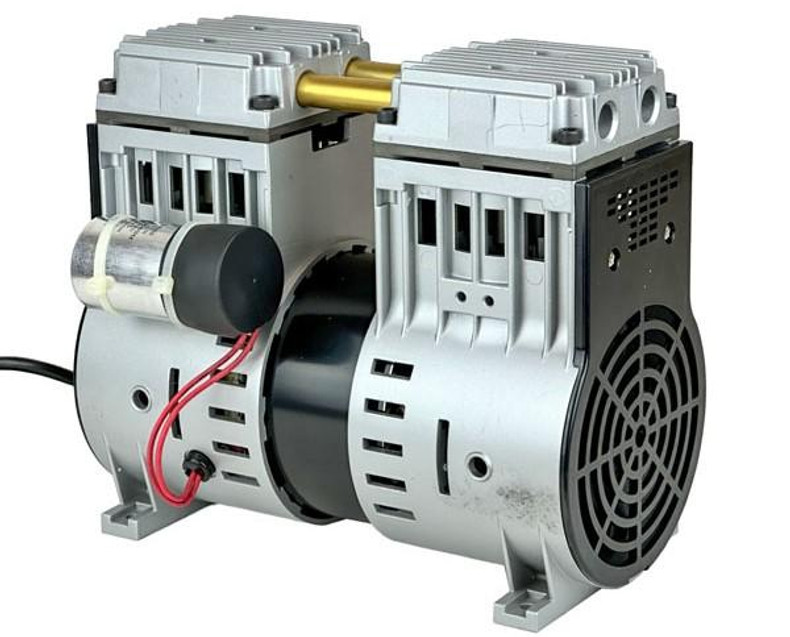
The Truth Behind Horsepower Ratings:
What Really Matters in an Aeration Compressor
Posted by Eric Pipkin on March 6, 2025
When comparing pond and lake aeration systems, it is easy to focus on the compressor’s advertised horsepower. A ¾ HP compressor sounds more powerful than a ½ HP compressor, so it may appear to be the better choice.
Unfortunately, horsepower alone does not tell you how well a compressor will perform in an aeration system.
Depending on how the rating is presented, horsepower can provide useful information—or create an impression of greater performance that is not supported by the compressor’s actual airflow and pressure capabilities.
Horsepower Is Only Part of the Story
Horsepower describes mechanical power. In an air compressor, that power is used to operate the internal pumping mechanism and produce compressed air.
However, two compressors with the same advertised horsepower can perform very differently. Compressor design, operating speed, efficiency, internal clearances, cooling, and the type of pumping mechanism all affect how much usable air the compressor delivers.
The reverse is also true: a compressor with a higher horsepower rating does not automatically provide more airflow at the pressure required by an aeration system.
That is why horsepower should never be used as the only basis for comparing compressors.
Electrical Input Is Not the Same as Mechanical Output
Amperage is also commonly used when describing compressors, but amperage by itself is not a direct measurement of horsepower.
For a single-phase AC motor, multiplying voltage by amperage gives apparent power in volt-amperes, or VA:
Volt-amperes = volts × amps
It does not necessarily give the motor’s actual wattage. Determining real electrical input power also requires the motor’s power factor:
Input watts = volts × amps × power factor
Mechanical output is lower again because no motor is 100% efficient:
Output horsepower = input watts × motor efficiency ÷ 746
One horsepower is approximately 746 watts of mechanical output. However, a motor must draw more than 746 watts electrically to produce one horsepower at its shaft because some energy is lost as heat, friction, and other internal losses.
This means that voltage and amperage can help you evaluate a compressor, but they cannot prove its actual horsepower or aeration performance by themselves.
Why Amperage Can Be Misleading
The current drawn by a compressor changes with operating conditions. A compressor may draw different amperage depending on:
-
the operating pressure;
-
the supply voltage;
-
the mechanical load;
-
the motor’s power factor and efficiency;
-
the compressor’s temperature; and
-
restrictions in the airline or diffuser system.
Nameplate amperage may also represent rated full-load current rather than the exact current the compressor will draw in every installation.
As a result, comparing two compressors solely by amperage can lead to the wrong conclusion. A compressor drawing more current may be producing more air, but it may also be less efficient or operating against greater pressure.
The Ratings That Matter Most
For pond and lake aeration, the most useful performance measurement is airflow at the pressure the compressor will actually encounter.
The primary specifications to compare are:
Airflow
Airflow is normally stated in cubic feet per minute, or CFM. This tells you how much air the compressor can deliver.
A maximum or unrestricted CFM rating is not enough. Airflow should be shown at several operating pressures because compressor output normally decreases as pressure increases.
Pressure Capability
Pressure is usually expressed in pounds per square inch, or PSI.
Water depth creates backpressure. As a general approximation, every 2.31 feet of freshwater depth creates about 1 PSI of static pressure. Additional pressure is required to overcome losses through the tubing, fittings, valves, check valves, and diffusers.
A compressor must therefore deliver adequate airflow at the total expected system pressure—not merely produce a high maximum-pressure number.
Power Consumption
Actual wattage helps show how much electricity the compressor uses. When combined with airflow at pressure, wattage can also help compare operating efficiency.
A compressor that delivers the required airflow while using less electricity may cost less to operate over its service life.
Duty Rating
Aeration compressors often operate continuously for long periods. The compressor should be designed for continuous duty under the temperature, pressure, and ventilation conditions of the installation.
Service Life and Maintenance
Diaphragms, piston cups, seals, bearings, filters, and other components eventually wear. Replacement-part availability, maintenance intervals, cooling, and rebuild costs may be more important over time than a small difference in advertised horsepower.
How to Compare Two Compressors Properly
When evaluating competing systems, ask for a performance curve or table showing airflow at several pressure levels.
For example, compare:
-
CFM at 0 PSI;
-
CFM at 5 PSI;
-
CFM at 10 PSI;
-
maximum continuous operating pressure;
-
actual electrical wattage at the intended operating pressure;
-
continuous-duty capability; and
-
recommended rebuild or maintenance intervals.
Make sure the specifications were obtained under comparable test conditions. A maximum-flow rating measured with no restriction cannot be fairly compared with another compressor’s airflow measured under pressure.
A Higher Horsepower Label Does Not Guarantee Better Aeration
Suppose one manufacturer replaces a nominal ½ HP compressor with a nominal ¾ HP model. That change may improve performance, but the horsepower label alone does not prove it.
The meaningful questions are:
-
Does it deliver more CFM at the required pressure?
-
Can it operate continuously at that pressure?
-
Does it consume more electricity?
-
Does it run hotter?
-
Is it louder?
-
Will it last longer?
-
Does it improve oxygen transfer in the intended system?
Unless the higher horsepower produces a measurable improvement in usable airflow or durability, the larger number may have little practical value to the pond owner.
The Bottom Line
Horsepower can be a useful motor specification, but it is not a complete measure of compressor performance. Amperage is also useful, but it cannot be converted directly into mechanical horsepower without additional information.
For an aeration compressor, focus on verified airflow at the required pressure, electrical consumption, operating temperature, duty rating, service life, and compatibility with the complete aeration system.
A larger number on a label does not aerate a pond. Usable airflow at the required depth does.