Solar Aerators
Solar Aerators
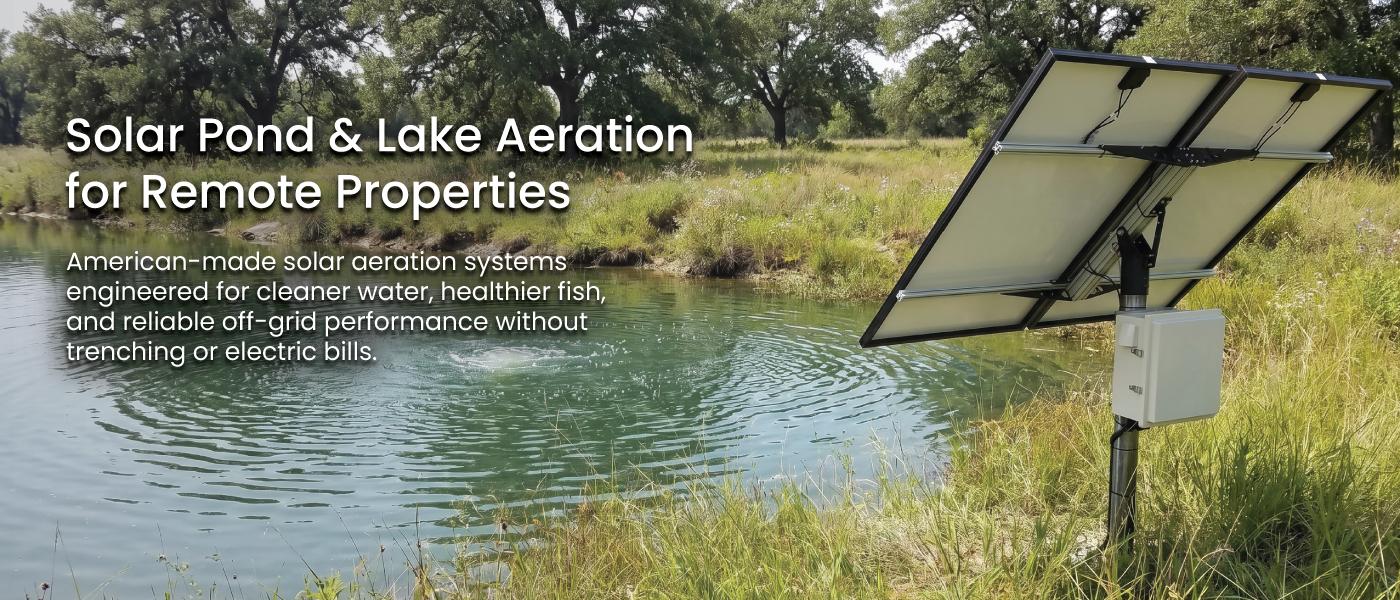
Solar pond and lake aeration systems for off-grid ponds, remote properties, livestock ponds, recreational lakes, and locations where utility power is not available.

No Electric Bill
Saves money year-round.
Runs on free solar energy.
Runs on free solar energy.

No Trenching
Easy Installation with no underground wiring needed.
Ideal for Remote Sites
Designed for off-grid locations where power is not available.
Low Maintenance
Built for long-term reliability with minimal upkeep.
Why Choose Solar Aeration?
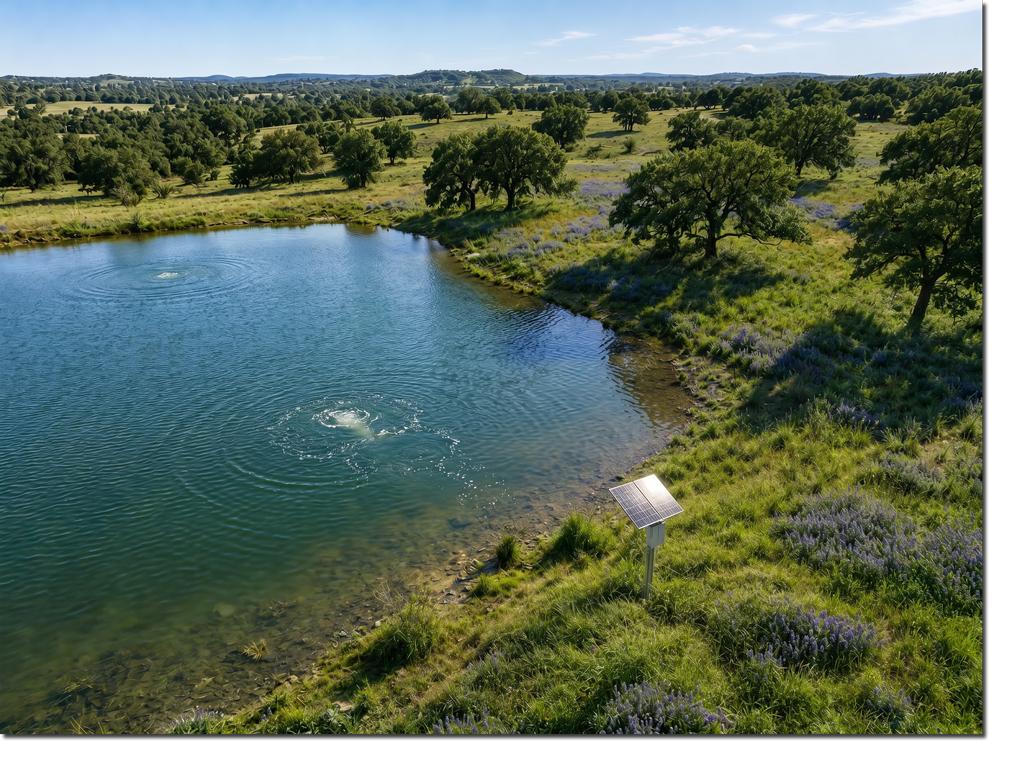
Solar pond aeration improves oxygen levels, reduces stagnation, reduces muck, supports healthier fish populations and helps maintain cleaner water - all without utility power.
Solar Direct systems are ideal for remote ponds, recreational lakes, livestock ponds, HOA water features, and off-grid properties where traditional electrical aeration is impractical.
Safer Startup with Slow Start™ technology
Most aeration problems happen during startup. Sudden turnover can destabilize water quality and stress or kill fish. It's 100% automatic and failsafe.
Slow Start™ gradually ramps system output over 15 days for a safer and more controlled startup.
Slow Start™ is an available option on all our aeration systems.
Learn About Slow Start™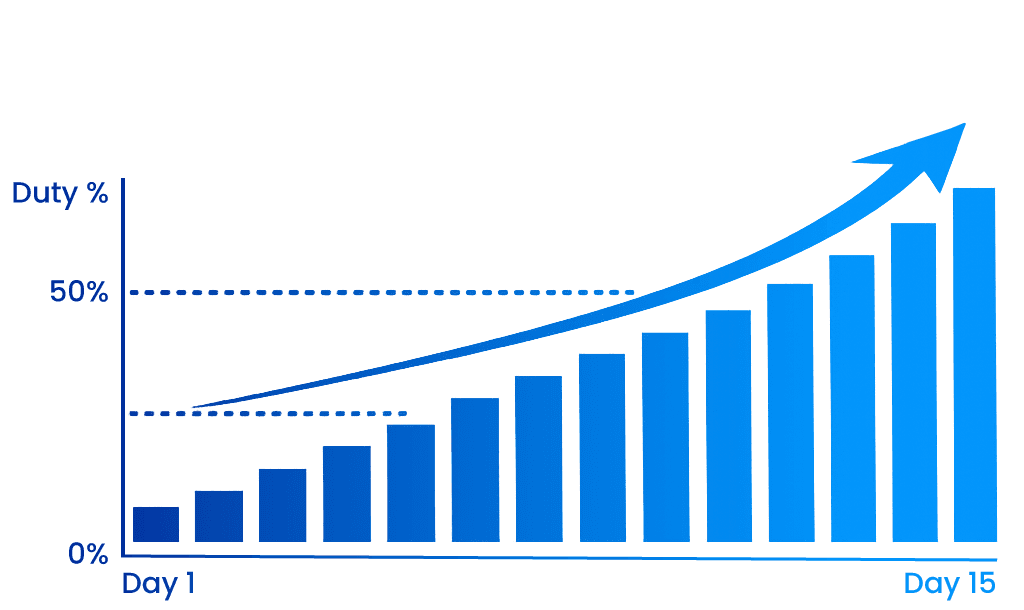
Find The Best Solar Aerator For Your Pond or Lake
Not Sure Which System Is Right for Your Pond?
New to solar? We're here to help. Our team has been working with solar for over 20 years. We can help you select the ideal solar aeration system for your pond, lake, or remote property based on size, depth, power availability, and application requirements.
We also offer a free system design service to help map and measure your pond or lake, recommend system sizing, and create a layout showing suggested aerator and diffuser locations.
Frequently Asked Questions About Solar-Direct Aerators
Search common questions about Solar-Direct pond aeration, daylight operation, batteries, sizing, installation, airflow, maintenance, and system selection.
Showing 24 questions
1 What is a Solar-Direct pond aerator?
A Solar-Direct pond aerator uses solar panels to power the aeration system directly during daylight hours. The SD-Series converts solar energy into 3-phase power for brushless rocking piston compressors, so the system can aerate a pond or lake without utility power, trenching, or batteries.
2 How does a Solar-Direct aerator work?
Solar panels produce DC power during daylight. The Solar-Direct controller converts that solar power into compressor power, and the compressor sends air through weighted airline to diffusers on the pond bottom. The diffusers release fine bubbles that move water and help improve oxygen transfer and circulation.
3 Do Solar-Direct aerators use batteries?
No. Solar-Direct systems are designed to operate without batteries. Eliminating batteries reduces system cost, improves efficiency, and removes battery maintenance and replacement from the basic system.
4 Do Solar-Direct aerators run at night?
No. A Solar-Direct aerator runs when sunlight is available and shuts down when solar production is not sufficient. If nighttime operation is required, a battery backup aeration system is the better choice.
5 Will a Solar-Direct aerator run on cloudy days?
Yes, solar production can continue during many cloudy conditions, but output depends on available sunlight. Heavy cloud cover, storms, snow on the panels, or shade can reduce compressor speed or cause intermittent operation until solar conditions improve.
6 How important is shade avoidance?
Shade avoidance is critical. Even a small amount of shade on part of the solar array can reduce production. The array should have clear, unrestricted access to direct sunlight during the day, with special attention to seasonal sun angle and nearby obstructions.
7 When should I choose Solar-Direct instead of electric aeration?
Solar-Direct is usually the right choice when utility power is not available near the pond, trenching would be expensive, or the customer wants aeration without a monthly electric bill. Electric aeration is often preferred when reliable grid power is already available close to the pond and 24-hour operation is required.
8 When should I choose Battery Backup instead of Solar-Direct?
Choose Battery Backup when the pond needs aeration after sunset, during extended cloudy conditions, or on a more controlled schedule. Solar-Direct is simpler and lower maintenance, while Battery Backup adds batteries and controls to extend runtime beyond daylight hours.
9 Can I add Battery Backup later?
Yes. Existing SD-Series Solar-Direct systems can be upgraded with a Battery Backup Unit when the system is configured with the required solar panel capacity. This lets a customer start with Solar-Direct and add battery operation later if site conditions or operating goals change.
10 What pond sizes do the SD-Series Solar-Direct aerators cover?
The SD-Series lineup is designed around pond size ranges: SD-1 for up to 1 acre, SD-2 for up to 2 acres, and SD-4 for up to 5 acres, with larger systems available when needed. Final sizing should also consider depth, shape, diffuser locations, water quality, and biological load.
11 How deep can a Solar-Direct aerator operate?
The SD-Series Solar-Direct specification lists an operating depth range of 2 to 40 feet of water. Diffuser depth, hose length, airflow balance, and compressor capacity should all be considered when designing the system.
12 How many solar panels does a Solar-Direct aerator need?
Panel count depends on the model. SD-1 and SD-2 systems can be configured with one or two solar modules depending on the package, while SD-4 systems use two solar modules as standard. For battery backup upgrades, two solar panels are required.
13 What type of compressor is used in the SD-Series?
The SD-Series uses 3-phase brushless rocking piston compressor technology. The larger SD-4 system uses dual 3-phase brushless rocking piston compressors for higher airflow.
14 How much airflow do the Solar-Direct aerators produce?
Published SD-Series specifications list 2.8 SCFM airflow for SD-1 and SD-2 configurations and 5.6 SCFM for the SD-4. Actual field output depends on sunlight, diffuser depth, hose layout, and system condition.
15 Does Solar-Direct aeration require trenching?
No utility trenching is required for Solar-Direct operation because the system is powered by its own solar array. The site still needs proper solar array installation, a mounting pole or structure, protected cable routing, and weighted airline running to the diffuser locations.
16 What installation location is best for a Solar-Direct aerator?
Choose a location with clear sun exposure, safe access, protection from flooding or high water, good enclosure ventilation, and practical hose routing to the diffuser locations. The manual also recommends keeping hose runs similar in length where possible.
17 What mounting pole is required?
The SD-Series solar racking is designed for an installer-supplied 3-inch SCH40 or SCH80 steel pole. The aerator enclosure pole-mounting plate can clamp to a 3-inch or 4-inch steel pole, depending on the installation hardware.
18 Can I install a Solar-Direct aerator myself?
Many installations are manageable for experienced DIY customers or professional installers, but the installer is responsible for code compliance, grounding, proper foundation and pole installation, safe solar wiring practices, and proper diffuser deployment. US Solar Mounts technical support is available for product selection and installation help.
19 How should the solar array tilt be set?
The SD-Series manual provides year-round tilt guidance by latitude: 20 degrees for 0 to 25 degrees latitude, 30 degrees for 25 to 35 degrees, 40 degrees for 35 to 45 degrees, and 50 degrees for 45 degrees or higher. Seasonal adjustment may improve production in some locations.
20 What maintenance does a Solar-Direct aerator need?
Routine maintenance includes keeping solar panels clean and unshaded, checking vents and fans, keeping compressor intake filters clean, inspecting weighted airline and fittings, and confirming diffusers are flowing properly. Restricted airflow or blocked ventilation can cause overheating and may not be covered under warranty.
21 How do I balance airflow between diffusers?
After startup, open the manifold ball valves and adjust them while watching the bubbles from each diffuser. The goal is to make the bubble streams approximately equal so airflow is distributed properly across the diffuser locations.
22 Can a Solar-Direct aerator help reduce algae and improve water quality?
Aeration can improve circulation, reduce stratification, increase dissolved oxygen, and support a healthier pond ecosystem. These improvements can help with water clarity, odor, muck digestion, and algae pressure, but aeration is not a standalone guarantee against every algae or water-quality problem.
23 Should I start a Solar-Direct aerator slowly on an older pond?
Yes. Older ponds can contain bottom muck, low-oxygen water, and trapped gases. The manual recommends intermittent operation at first, beginning with short daily runtimes and increasing gradually so gases can escape and the pond ecosystem can adjust.
24 Can I use a Slow Start controller with a Solar-Direct aerator?
For standard Solar-Direct systems, startup should be managed according to the Solar-Direct operating instructions and site conditions. Slow Start controllers are primarily used with compatible 120V AC aeration systems. If you are unsure which startup method applies to your system, contact US Solar Mounts before commissioning.
No matching Solar-Direct FAQs found.