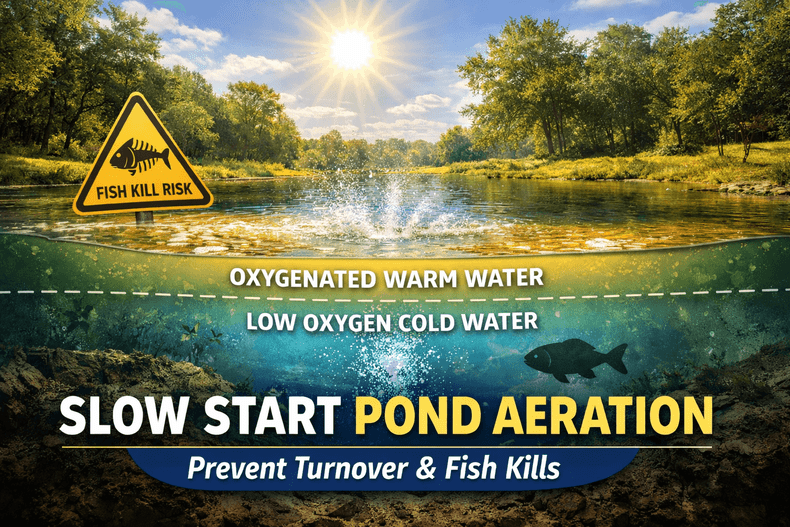
Slow-Starting Bottom-Diffused Pond Aeration: The Safest Startup Method
If you’re starting (or restarting) bottom-diffused aeration, the single biggest mistake pond owners make is running it “like a light switch” in warm weather: OFF for months, then ON for long hours immediately.
That warning isn’t folklore. It’s grounded in how ponds behave when they warm up, how oxygen gets distributed (and trapped), and how quickly a diffuser system can change the entire water column. Done too fast, it can trigger a man-made turnover event — the same kind of oxygen shock that’s associated with fish kills.
This article explains the science in plain English, then lays out a startup method that aligns with university/Extension guidance and professional lake management best practice.
What “Slow Start” means
Slow Start means increasing aeration run time in deliberate steps over multiple days so the pond is mixed progressively, not abruptly.
Slow start does not mean:
- “Run it only at night,” or
- “Just run it less forever,” or
- “It’s only needed for brand-new systems.”
Slow Start is a start or restart protocol used when there’s a meaningful chance the pond is thermally stratified and the deeper water has become oxygen-poor.
Why Fast Startup Can Cause Turnover
1) Warm ponds commonly form layers that resist mixing
When the sun warms the surface, many ponds develop a warm upper layer floating over cooler bottom water. These layers can become separated enough that the pond doesn’t fully mix on its own. That separation is what people mean by stratification (and the boundary between layers is often referred to as a thermocline).
2) Bottom water can become oxygen-depleted
Once a lower layer is cut off from the surface, it doesn’t get oxygen from wind mixing or direct contact with air. Meanwhile, organic material on the bottom continues consuming oxygen. Over time, the deeper layer can drop to low dissolved oxygen (DO).
3) Bottom-diffused aeration is extremely good at moving water
A diffuser doesn’t just “add oxygen.” It creates a rising bubble plume that lifts bottom water upward, which can circulate and mix the pond far more quickly than many people expect.
4) Rapid mixing can spread low-oxygen water through the fish zone
If the bottom layer is very low in oxygen, aggressively mixing the whole pond too quickly can pull that low-oxygen water upward and distribute it into the water column where fish live and breathe. The result can be a sharp DO drop — and that’s when fish stress and fish kills become possible.
This is the core reason slow-start exists:
gradual mixing reduces the chance of a sudden, pond-wide oxygen crash.
When you must use a Slow Start
You can often start immediately when:
- The water is cold and stratification is weak or absent.
Some Extension guidance notes that in colder conditions (e.g., surface water in the 40s °F), it’s typically safer to start aeration without a long ramp because a strong stratified structure usually hasn’t formed.
You should assume slow-start is needed when:
- The pond has been through extended warm weather, especially if it is moderate to deep.
- You’re starting in late spring/summer or after a long shutdown.
- You suspect a strong thermocline or you’ve seen summer symptoms that suggest stratification (e.g., noticeably cooler water at depth, persistent “stale” bottom smell when disturbed, etc.).
- You’re not sure — and you want the most conservative, defensible approach.
If you have a DO/temperature meter, measuring the top and bottom before startup is ideal. If you don’t, slow-start is the safest default in warm months.
Various Methods
Different universities and professionals describe slightly different schedules, but they agree on the principle: increase run time in steps and avoid “full runtime on day one” when stratification is likely.
Here are two schedules that are widely consistent with published guidance:
Option A: The classic doubling ramp (simple and effective)
- Day 1: 30 minutes
- Day 2: 1 hour
- Day 3: 2 hours
- Day 4: 4 hours
- Day 5: 8 hours
- Continue increasing until you reach your target daily runtime (often continuous operation for destratification goals)
Why it works: it provides a steep enough ramp to get you operational quickly while still limiting the first few days — when the risk of mixing oxygen-poor bottom water is highest.
Option B: The warm-season “two-week conservative ramp”
Some Extension guidance is even more cautious for warm-season installs, describing very short initial runtimes and gradual increases over roughly two weeks. The purpose is the same — just with more time and finer steps.
Why it works: it prioritizes risk reduction in ponds where you strongly suspect the lower layer has been oxygen-depleted for a long time.
Which option should you use?
- If you’re starting in cooler conditions: you may not need a long ramp.
- If you’re starting in warm conditions and want a conservative approach: use the longer ramp or finer steps.
Both methods are rooted in the same defensible objective: avoid rapid whole-pond mixing when the bottom layer may be oxygen-poor.
What to watch for during startup
During the first several days, pay attention to fish behavior and water conditions. If fish appear stressed (classic example: gulping at the surface, often called “piping”), treat it as a warning sign. In that scenario, reduce mixing intensity and focus on restoring oxygen.
Also be mindful of external conditions. Windy days and storm fronts can naturally increase mixing — which can combine with aeration mixing. The conservative move is to avoid stacking multiple “mixing drivers” all at once early in the ramp.
After the ramp: consistency matters
Once a pond is fully mixed, many experts advise running in a way that avoids re-establishing stratification if destratification is your goal. Intermittent operation can allow partial layering to return, which can reintroduce the turnover risk the next time the system runs hard.
In other words: slow-start is about the restart window. After that, your operating schedule should match your pond goals (destratification, water quality improvement, etc.) and your power strategy (grid, solar, hybrid).
The “7-day slow start” tradition — useful, but not a law of nature
You’ll hear “do a 7-day startup” repeated constantly. As a rule-of-thumb, it pushes people in the correct direction: gradual mixing instead of instant full-time runtime.
But it’s important to state this accurately:
- Seven days is a convenient framework — not a biological requirement.
The science doesn’t care about the number seven. It cares about how rapidly you mix an oxygen-poor bottom layer into the water column.
A plausible origin story (clearly labeled as a hypothesis)
Many pond owners and installers believe the “7-day” habit became popular because basic off-the-shelf timers historically made it easy to think in one-week blocks: set a daily time, then adjust it day by day for a week. That explanation is reasonable — but it’s hard to prove historically because most technical publications focus on the mechanism and risk, not the history of timer hardware.
Professionally speaking, the most defensible way to say it is:
- Seven days is a common, memorable ramp template.
- Some ponds justify longer, finer ramps — especially during warm-season starts — because risk varies by pond depth, stratification strength, and oxygen demand.
Why a 14-Day Slow Start Controller is Better
Traditional timer-based ramps are often limited by two things:
- Human consistency (someone has to remember to change settings repeatedly), and
- Timer granularity (many common timers aren’t designed for flexible multi-week ramps with intelligent daily scheduling).
A purpose-built slow-start controller removes both limitations.
What the US Solar Mounts Slow Start Controller can do that basic timers typically can’t
- Supports up to 14-day slow-start ramps (longer, smoother, and more adjustable than the common “one-week habit”)
- Can run the compressor shortly after sunup, or use Day Centering technology to target operation near the middle of the day
- With Day Centering, the controller expands runtime outward in both directions from mid-day as the ramp progresses — so the daily run window grows while staying centered on your most solar-supportive hours
Why that matters:
- A longer, finer ramp aligns with the same conservative goal recommended by Extension and professionals: avoid rapid destratification when stratification is likely.
Put simply: the controller doesn’t “change pond science.” It lets you apply best-practice pond science more reliably — and with more scheduling control than basic weekly timers.
Bottom line
Slow-starting bottom-diffused aeration is not a marketing add-on. It’s a practical way to reduce the known risk associated with rapidly mixing a stratified pond — especially in warm-season startups.
- Treat warm-season restarts as slow-start situations unless you can confirm otherwise.
- Use a schedule that ramps runtime gradually enough to avoid a pond-wide DO shock.
And if you want that process to be consistent, repeatable, and optimized, modern multi-week slow-start control is a clear step forward from the old “timer-and-hope” method.
References
- Clemson University Extension — Aeration/Circulation (includes cautions about turnover risk and staged startup guidance)
https://www.clemson.edu/extension/water/stormwater-ponds/problem-solving/aeration-circulation.html - Clemson HGIC — Pond turnover and dissolved oxygen (turnover mechanism and DO implications)
https://hgic.clemson.edu/factsheet/pond-turnover-and-dissolved-oxygen/ - The Ohio State University SENR — “Your Pond Update” (example gradual startup guidance; cold-water note; doubling schedule concept)
https://senr.osu.edu/Your%20Pond%20Update - Texas A&M AgriLife (Texas Wildlife / AgriLife Today) — Pond maintenance, stratification/turnover risk context
https://wildlife.tamu.edu/2019/06/pond-maintenance-boosts-performance-prevents-catastrophes/ - Texas A&M AquaPlant — Dissolved oxygen thresholds FAQ (stress/kill context)
https://aquaplant.tamu.edu/faq/dissolved-oxygen/